
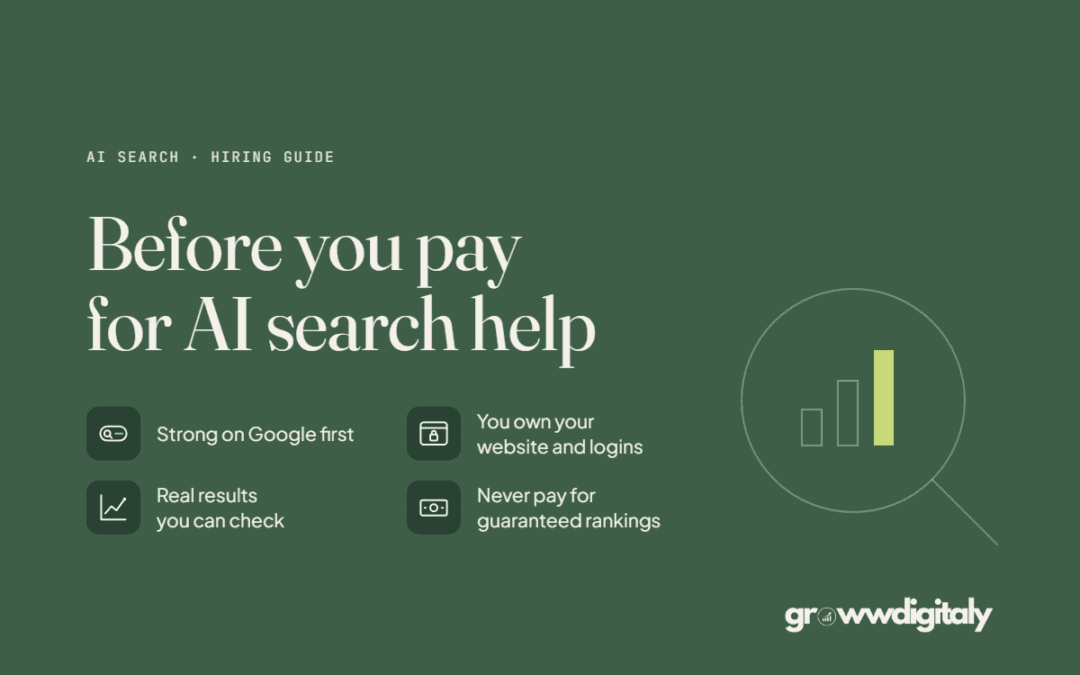
How to choose someone to optimise your website for ChatGPT and AI Overviews comes down to four checks.
Do they fix your Google basics first?
Do they keep every account in your name?
Can they show proof you can check yourself?
And do they refuse to guarantee AI citations?
Yes to all four, and you’re talking to the right person. A promise that you’ll be “the business ChatGPT recommends” by next month? Walk away.
I’m Shweta, a UK-based SEO and AI search specialist. Small business owners ask me this a lot, often after a cold email warning that their competitors show up in ChatGPT and they don’t. This is the list I’d use if I were hiring me.
Key takeaways
- Google first. AI tools lean on your Google presence.
- Own your accounts before you hire anyone.
- No one can guarantee an AI citation.
- Fear-based cold emails are a warning sign, not a brief.
- Ask for proof you can open in Search Console.
- Realistic timelines run from 3 months to a year.
What kind of specialist can actually get a small business recommended by ChatGPT and AI Overviews?
An SEO specialist who also understands AI search. Not just a web designer, and not someone selling AI tricks. The right person fixes how Google sees your business first, makes your website easy for AI tools to read, and builds genuine mentions of you on other trusted sites. That combination gets small businesses recommended.
Even Google’s guide to optimising for AI Overviews and AI Mode calls it “still SEO.”
So the person you want does three jobs:
- Access: AI crawlers can actually read your site.
- Clear answers: your pages answer what customers really ask.
- Trust beyond your website: reviews, directories, and real conversations on places like Reddit and Quora.
You can see how I handle all three on my AI search optimisation service page.
Before you hire anyone, own these accounts so you can never be locked out of your own business
Before you pay anyone, make sure you own and can log in to your Google Search Console, Google Analytics, website, and Google Business Profile. Then check your reviews, business description, and photos. Without these, the first weeks of any project go on recovering access instead of getting results.
One client came to me after a bad experience with someone else. I asked for the basics: Search Console, Analytics, and their website login.
They had none of them. Not one.
So they couldn’t check what their last provider had done. Honestly? That’s when I realised how exposed a small business can be.
Tick these off first:
- Search Console and Analytics in your business’s name, with you as admin
- Your website login (WordPress, Wix, Squarespace)
- Google Business Profile with you as owner. Add outside help as a manager using Google’s owner and manager settings, so nobody can remove you
- Real, recent reviews
- A clear description of what you do and where
- Photos of your actual business
Many small businesses I work with have almost no reviews, a thin description, and hardly any photos. AI tools can’t recommend a business they can’t verify.
In short: AI search starts with basics you already control. Own your accounts, complete your Google Business Profile, and collect real reviews before paying for anything clever.
Questions to ask before you pay, so you know exactly what you’re buying
Ask what they check first, which AI tools they test, how they’ll get you mentioned beyond your website, what you’ll see each month, and what happens if you leave. Good answers are specific and in plain English. Vague answers full of acronyms usually mean vague work.
1. “What do you check first?”
Good answer: your website, social accounts, and Google visibility, before any AI tool.
2. “Which AI tools will you test, and with which prompts?”
Good answer: real customer questions, run across ChatGPT, Perplexity, Gemini, and Google AI Overviews.
3. “How will you get my business mentioned outside my own website?”
Good answer: a plan based on where your customers actually talk.
For a healthcare brand, I read forums to see how people described their worries in their own words. I built content around those conversations, then contributed on Reddit, Medium, and Quora. Domain authority went from 15 to 28 in six months, and the brand started appearing in AI-generated answers (a very exciting moment, not gonna lie).
4. “What will I see each month?”
Good answer: real examples, links, and data you can open yourself. Too many owners pay for months without seeing one.
5. “What happens if I want to leave?”
Good answer: a clear notice period, and every account and piece of content stays yours.
6. “What questions do you have about my business?”
A good specialist asks before they sell.
A cricket ground owner once gave me a brief that was basically: “Please do marketing… how, no idea.” After some research, I realised the first goal wasn’t bookings. It was awareness. So I used Codex to build a simple QR app where players take a selfie after their match and share it, tagging the ground. In one week: 142 brand mentions and a 4% engagement rate.
Red flags that should make a small business owner walk away before spending a penny
Walk away if someone guarantees AI citations, sells a paid spot inside ChatGPT’s answers, opens with fear about your competitors, pushes “AI schema” as the fix, or keeps your accounts in their name. Honest specialists talk about effort and evidence, not promises.
Guaranteed citations. Google has said for years that “no one can guarantee a #1 ranking on Google.” Google’s own advice on hiring an SEO applies just as much to AI answers.
My own name now appears in AI answers on ChatGPT, Gemini and Perplexity when asked share a list of 50 people who work at the intresection of SEO, Content and AI workflows. I still can’t promise that for you. I can promise the work that made it possible.
A “paid spot” in ChatGPT’s answers. ChatGPT does now run ads, but OpenAI’s ad principles say they’re labelled, kept separate, and don’t influence the answers.
The fear pitch. “Your competitors are in ChatGPT and you’re not.” Real help starts with questions, not panic.
The “AI schema” upsell. Google’s guide says there’s no special schema or llms.txt file you need for its AI features.
In short: anyone can put “AI search” on a website. Look for someone who refuses to guarantee results, keeps your accounts in your name, and explains every step in plain English.
How to check a specialist’s proof yourself, so you’re not relying on screenshots they chose
Ask them to walk you through real data, not a hand-picked screenshot. Search Console now has a Generative AI report showing how often a site’s pages appear in AI Overviews and AI Mode. Ask to see theirs, then test a few prompts in ChatGPT and Perplexity yourself.
Google launched its Search Generative AI performance report in June 2026, and it’s now on every site. It counts impressions only, not clicks.
Then ask ChatGPT or Perplexity about the specialist. If they can’t get their own business mentioned, ask why.
Specialist or agency: which gives a small business more for its budget?
For most small businesses, a specialist who does the work personally gives better value. You speak to the person doing the work, the strategy is built around you, and a small budget goes further. An agency makes more sense when you need lots of services running at once.
I helped grow a salon business from scratch on INR 30,000 over six months, using Facebook, Instagram, Google Business Profile, and Meta ads with a lot of A/B testing (trying two versions to see which works better).
Today it brings in revenue from existing clients, referrals, and Google Business Profile leads. Without relying on ads.
Good work keeps paying off after the spend stops. But if you need ads, PR, and a new website at once, an agency may suit you better.
What happens after you hire, so you know your money is working
A good engagement starts with an audit, not a package. Expect your specialist to review your website, social accounts, and online presence, fix your Google foundations, then build your AI visibility. Results can take anywhere from 3 months to a year, depending on where you start.
This is how I work:
- Free audit of your online presence
- Google first: profile, reviews, technical health
- Then AI search: access, answers, trusted mentions
- Monthly reporting you can check
For what each budget level realistically buys, see how much AI search optimisation costs in the UK.
Frequently Asked Questions: How to choose someone to optimise your website
Can anyone actually guarantee my business will show up in ChatGPT?
No. Nobody controls what ChatGPT, Perplexity, or Google AI Overviews say. A good specialist can promise the work, the method, and honest reporting.
I got an email saying my competitors show up in ChatGPT and I don’t. Should I worry?
Check it yourself first. Ask ChatGPT and Perplexity about your type of business in your town. If you’re missing, read why your business isn’t showing up in AI search before paying anyone.
How long until a small business shows up in ChatGPT or Perplexity after hiring someone?
Anywhere from 3 months to a year, depending on your reviews, Google profile, website health, and competition. Be wary of anyone who gives a date before looking at your business.
My last SEO person set up my Google accounts. What should I do before hiring someone new?
Ask them to make you the owner of Search Console, Analytics, and your Google Business Profile, then remove their access. If they don’t respond, a new specialist can help you recover them.
Can I do some of this myself on a small budget?
Yes. My 10-step checklist to optimise your website for AI search covers the basics, and local businesses can follow my A week plan for getting recommended by AI search.
If you’ve been burnt before, start here
If you’ve paid someone who didn’t deliver, I get it. So don’t trust. Check.
Ask the questions. Ask for access. Ask for proof you can open yourself.
And if you’d like me to look at where your business stands on Google and AI search, I’ll start with a free audit. No package, no pressure, just an honest picture.

Shweta Gupta is a UK-based marketer specialising in SEO, content strategy, and AI-assisted marketing workflows. She has experience across SEO, paid media, content optimisation, website management, and digital marketing across various industries.