
TL;DR
- If your business is only focused on traditional SEO, you may still get Google rankings, but you could miss visibility inside AI-generated answers.
- SEO helps your website rank on Google. GEO, or Generative Engine Optimisation, helps your brand become visible in AI tools like ChatGPT, Perplexity, Gemini, and Google AI Overviews.
- I see SEO and GEO like skincare and makeup.
- SEO is your skincare. It is the cleanser, serum, moisturiser, and SPF. It builds the base. GEO is the makeup. It enhances visibility, brings the finish together, and helps you show up in new places.
- But makeup will not sit well on neglected skin.In the same way, GEO will not work properly if your SEO foundation is weak.
- SEO is the foundation. GEO is the visibility layer on top. You need both.
Key Findings
- SEO is not dead. It is still the foundation for organic visibility.
- GEO is not replacing SEO. It builds on top of SEO and helps AI tools understand, trust, and cite your brand.
- Generic content is becoming less useful. AI tools need clear, specific, well-structured, source-backed content.
- Small businesses can compete. You do not need a huge budget. You need expertise, structure, consistency, and authority.
- Real experience matters. In one healthcare project, I grew Domain Authority (Moz) from 15 to 28 in six months and the brand started appearing in LLM-generated responses.
- The future of search is not only about ranking. It is about being referenced, trusted, and included in answers.
The Problem with small businesses: You Have Content, But AI Still Ignores You
You have a website.
You have blog posts.
Maybe you have even done keyword research, added headings, updated meta titles, and published regularly.
And still, something feels off.
Your traffic is modest. Leads are inconsistent. You may rank for a few search terms, but when someone asks ChatGPT, Perplexity, or Gemini a question related to your service, your brand does not appear.
That is the new visibility gap.
A few years ago, the question was:
“How do I get to page one of Google?”
Now the question is also:
“How do I become the answer when someone asks AI?”
And honestly! That second question is where many small businesses are stuck right now.
Not because they are doing everything wrong, but because the search landscape has changed faster than most content strategies have.
SEO vs GEO: The Skincare and Makeup Analogy
Let me explain this in the simplest way I can.
Think of SEO as skincare.
Your cleanser is your technical SEO. It clears the foundation. It removes the mess: crawl issues, broken links, poor structure, slow pages, indexing problems.
Your serum is your content strategy. It targets specific problems. It goes deeper. It helps improve the health of your website over time.
Your moisturiser is your on-page optimisation. It keeps everything balanced: headings, internal links, metadata, readability, and structure.
Your SPF is your authority building. It protects your brand long term through backlinks, mentions, trust signals, and expertise.
Now think of GEO as makeup.
It enhances what is already there. It makes your brand more visible across AI platforms. It helps your content show up in ChatGPT answers, Perplexity citations, Gemini summaries, and Google AI Overviews.
But here is the thing.
If your skin is not cared for, makeup can only do so much.
It might cover for a while, but it will not last. It will not sit properly. It will not create the result you want.
That is exactly how I see SEO and GEO.
If your website has weak technical SEO, thin content, unclear expertise, poor internal linking, and no authority signals, then GEO will struggle. AI tools need something strong to understand and trust.
GEO does not magically fix weak SEO. It enhances strong SEO.
What Is SEO?
SEO, or Search Engine Optimisation, is the process of improving your website so it can rank better on search engines like Google.
It includes:
- Technical SEO
- On-page optimisation
- Keyword research
- Content strategy
- Internal linking
- Backlink building
- User experience
- Structured data
- Helpful, reliable content
But good SEO is not just about rankings. What I love most about SEO, and I mean genuinely love, not in that corporate “passionate about synergy” kind of way, is that it forces you to think from the user’s perspective.
You cannot just stuff keywords and hope for the best anymore.
You have to ask:
- What is this person really looking for?
- What problem are they trying to solve?
- What answer would actually help them?
- What trust signals do they need before they choose a brand?
That is why SEO is still essential. Because AI search also needs the same things: clarity, usefulness, expertise, and trust. Google’s own guidance says its ranking systems are designed to reward helpful, reliable, people-first content, not content created mainly to manipulate search rankings.
What Is GEO?
GEO stands for Generative Engine Optimisation. Search Engine Land describes GEO as the process of positioning your brand and content so AI platforms like Google AI Overviews, ChatGPT, and Perplexity can cite, recommend, or mention you when users search for answers.
These tools include:
- ChatGPT
- Perplexity
- Gemini
- Claude
- Google AI Overviews
- Microsoft Copilot
Traditional SEO asks:
“Can this page rank on Google?”
GEO asks:
“Would an AI tool use this content as part of an answer?”
That is a very different question.
Because AI tools are not only looking for keywords. They are looking for clear explanations, trusted sources, specific examples, consistent brand mentions, and content that directly answers user questions.
This is why generic content is becoming a problem.
A blog called “10 SEO Tips for Small Businesses” may rank somewhere on Google. But will AI cite it?
Maybe not.
Because there are thousands of similar articles saying the same thing. AI tools need a reason to choose you.
SEO vs GEO: The Practical Difference
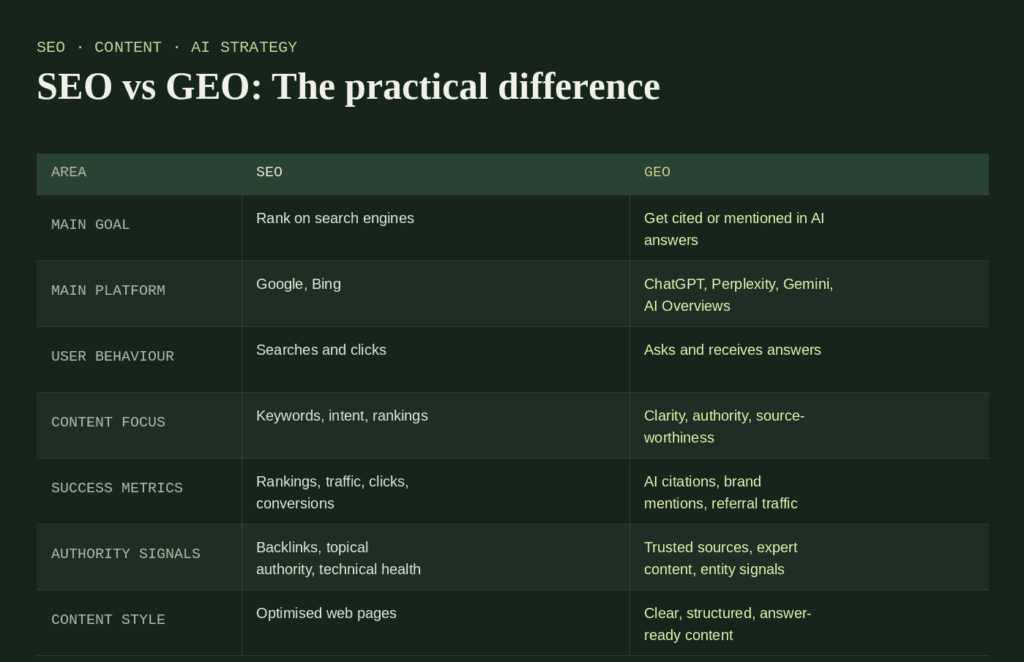
The important thing is this: SEO and GEO are not fighting each other. They work together.
SEO gets your foundation right. GEO helps your brand become visible in the new layer of search. WordStream explains GEO as optimising content to appear inside AI-generated answers, not just traditional search results.
A Real-World Example: How SEO + GEO Worked in Practice
Here is an example from my own work.
I worked with a healthcare brand where the starting point was not perfect. The website needed on-page improvements, technical fixes, stronger authority, and a better content structure.
So I started with research.
Not quick keyword research and done. Actual research.
I looked at how people were talking about their healthcare concerns in forums. I studied the words they used. I looked at the questions they were asking on community platforms. I paid attention to the fears, confusion, and language patterns that normal keyword tools do not always show.
That part matters because real people do not always search like marketers think they search.
Then I built the strategy around that.
The work included:
- On-page SEO improvements
- Technical SEO fixes
- Authority building
- Helpful blog content based on audience questions
- Stronger internal linking
- Clear source citation
- LinkedIn promotion
- Contributions across platforms like Reddit, Medium, and Quora
Over six months, the brand’s Domain Authority (Moz) improved from 15 to 28.
That was a strong SEO result.
But the more exciting part was what happened next.
The brand started appearing in LLM-generated responses. The content ranked on Google, but it also started getting picked up in AI-generated answers for related healthcare marketing queries.
That was the moment I realised this was not just SEO anymore.
This was SEO + GEO working together.
Real work. Real outcomes.
What Changed When I Added GEO Thinking?
The biggest change was not using a fancy new tool.
It was changing the way I planned content.
Before, a traditional SEO brief might focus on:
- Target keyword
- Search volume
- Competitor headings
- Word count
- Backlink gap
- Meta title
- Internal links
All of that still matters.
But with GEO, I also started asking:
- Is this content specific enough to be cited?
- Does it show first-hand experience?
- Are claims backed by credible sources?
- Is the structure easy for AI tools to understand?
- Does the author profile support trust?
- Is the brand visible beyond its own website?
- Are there clear examples, data points, and definitions?
- Would I trust this answer if I saw it in ChatGPT?
That last question is the big one.
Would I trust this answer?
Because if I would not trust it, why would an AI tool?
Why Small Businesses Should Care About GEO Now
I know what some business owners are thinking.
“Do I really need one more thing to worry about?”
Fair question.
Small businesses already have enough on their plate: sales, cash flow, content, social media, customer service, ads, emails, and the small matter of actually running the business.
But GEO is not about doing something completely separate.
It is about improving what you are already doing.
If you are already writing blogs, make them clearer and more useful.
If you are already posting on LinkedIn, make your expertise easier to understand.
If you are already doing SEO, start checking whether AI tools mention your brand.
If you already answer customer questions, turn those answers into structured content.
You do not need a massive team.
You need a sharper strategy.
EMARKETER forecasts that nearly a third of the US population will use generative AI search in 2026, which shows why AI visibility is no longer just an enterprise marketing issue.
My SEO + GEO Framework for Small Businesses
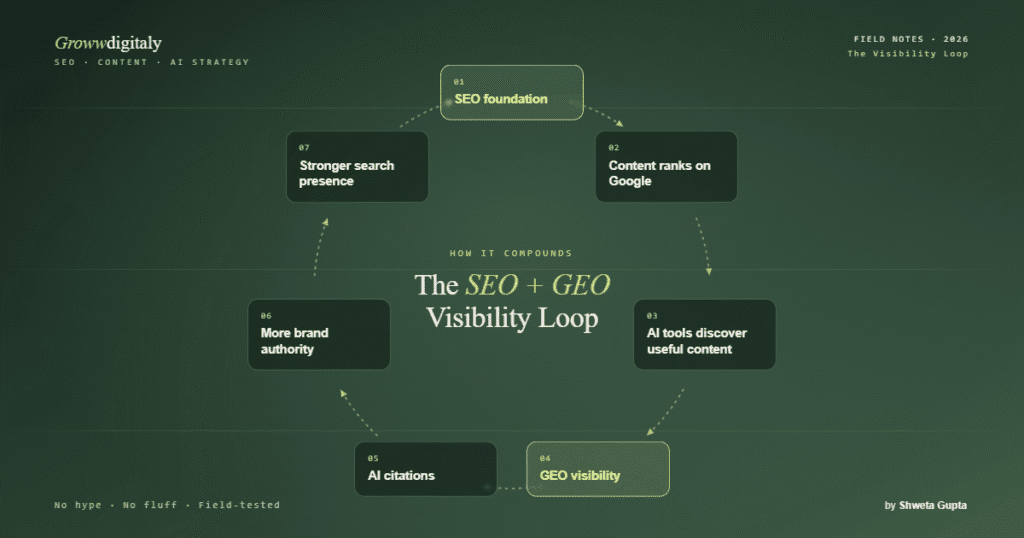
Here is how I would approach it.
1. Fix Your SEO Foundation First
Do not jump straight into GEO if your SEO basics are broken.
Start with:
- Technical SEO audit
- Crawlability checks
- Indexing issues
- Page speed
- Mobile usability
- Internal linking
- Schema markup
- Meta titles and descriptions
- Clear site structure
This is your skincare base. If the foundation is weak, the visibility layer will not hold.
Search Engine Land also notes that technical GEO overlaps with traditional SEO, especially around schema markup, crawlability, and helping AI systems parse your content.
2. Build Content Around Real Questions
Do not only rely on keyword tools.
Use them, yes. But do not stop there.
Look at:
- Reddit threads
- Quora questions
- LinkedIn comments
- Google People Also Ask
- Customer emails
- Sales calls
- Support queries
- Competitor reviews
- Industry forums
This is where you find the language your audience actually uses.
And honestly, this is where the best content ideas usually come from.
Not from chasing every high-volume keyword, but from understanding what people are really trying to solve.
3. Add First-Hand Experience
This is where small businesses have an advantage.
You have real stories. Real customers. Real mistakes. Real lessons. Real results.
Use them.
Instead of writing:
“SEO helps businesses improve visibility.”
Write:
“In one healthcare project, I improved Domain Authority (Moz) from 15 to 28 in six months by combining technical SEO, content strategy, and authority building.”
Specific beats generic.
Every time.
4. Cite Credible Sources
If you make a claim, support it.
Good sources for SEO and GEO content include:
- Google Search Central
- Search Engine Land
- WordStream
- EMARKETER
- Reuters
- Original research reports
- Industry studies
- Tool data, where relevant
This helps readers trust you.
It also helps AI tools understand that your content is connected to credible information.
5. Structure Content Clearly
AI tools need clarity. Humans need clarity too.
Use:
- Clear H2s and H3s
- Definitions
- Short paragraphs
- FAQs
- Tables
- Step-by-step sections
- Internal links
- External sources
- Author bio
- Dates where relevant
- Specific examples
This does not mean writing robotic content. It means making your expertise easy to understand.
6. Build Authority Beyond Your Website
Your website matters.
But it is not the only place AI tools may look.
Build your presence across:
- Quora
- Medium
- Industry communities
- Podcasts
- Guest articles
- Digital PR
- Google Business Profile, where relevant
For the healthcare brand, the off-site presence mattered. LinkedIn content, forum-led research, and platform contributions all helped create stronger authority signals.
That is the part many businesses miss.
SEO is not only what happens on your website anymore.
7. Track AI Visibility
Start checking how your brand appears in AI tools.
Ask questions like:
- “Best [service] for [industry]”
- “Who offers [service] in [location]?”
- “How can small businesses improve [topic]?”
- “What are the best examples of [your expertise area]?”
- “Which brands are known for [your service]?”
Check whether your brand appears.
Check which competitors appear.
Check which sources AI tools cite.
Then look for patterns. This is not perfect tracking yet. Because GEO measurement is still evolving, EMARKETER notes that the terminology around GEO and AEO is still unsettled and that vendor hype is common.
Final Thoughts
I do not believe SEO is dead.
Not even close.
But I do believe SEO has a new partner.
For a long time, businesses focused mainly on ranking on Google. That still matters. But now your audience may find you through a Google result, a ChatGPT answer, a Perplexity citation, a LinkedIn post, a Reddit discussion, or a Google AI Overview.
That means your content needs to be useful in more than one place.
And this is where SEO + GEO becomes powerful.
SEO gives your brand the foundation.
GEO helps your brand become part of the answer.
Just like skincare and makeup, one supports the other. You can have the best makeup products in the world, but if the base is neglected, the result will not last.
Same with search.
You can chase AI visibility, but if your SEO foundation is weak, your brand will struggle to show up consistently.
So start with the base. Build useful content. Show your experience. Strengthen your authority. Make your content clear enough for humans and AI tools to understand.
And if you do that early, you give your business a real advantage.
Not hype.
Not magic.
Just strategy, structure, and consistency.
Frequently Asked Questions: SEO vs GEO
What is the difference between SEO and GEO?
SEO helps your website rank on search engines like Google. GEO helps your brand appear inside AI-generated answers from tools like ChatGPT, Perplexity, Gemini, and Google AI Overviews.
The simple version: SEO helps people find your website. GEO helps AI tools recognise your brand as a source worth citing.
Is GEO replacing SEO?
No. GEO is not replacing SEO.
GEO builds on SEO. If your website has weak technical structure, thin content, unclear expertise, or poor authority signals, AI tools are less likely to trust and cite it.
SEO is the foundation. GEO is the next layer.
Why is my website ranking on Google but not appearing in ChatGPT?
Your website may rank for certain keywords, but that does not automatically mean AI tools see it as the best source to cite.
AI tools often look for clear answers, trusted sources, strong author signals, specific examples, and brand authority across the web. If your content is generic, unsupported, or only visible on your own website, it may not be picked up.
Do small businesses need GEO?
Yes, especially if your customers are starting to use AI tools for research, recommendations, and decision-making.
Small businesses do not need to do everything at once. Start by strengthening your SEO foundation, improving your content quality, adding first-hand experience, and building authority across platforms like LinkedIn, Reddit, Quora, and Medium.
How do I optimise my content for AI search?
Start with these steps:
- Answer real customer questions clearly
- Add first-hand experience and examples
- Cite credible sources
- Use clear headings and structured sections
- Add FAQs
- Build internal links
- Grow your brand presence beyond your website
- Track whether AI tools mention your brand
The goal is not to trick AI tools. The goal is to become useful enough to be referenced.
How long does GEO take to work?
There is no fixed timeline.
GEO is still emerging, and AI platforms do not work exactly like traditional search engines. But if you already have strong SEO, useful content, and clear authority signals, you are in a better position to build AI visibility over time.
Think in months, not days.
Can I do SEO and GEO myself?
You can start with the basics yourself.
You can improve your website structure, answer customer questions, cite reliable sources, and post more useful insights on platforms like LinkedIn and Reddit.
But if you want a complete strategy that connects technical SEO, content, GEO, and AI visibility, working with a specialist can help you avoid random content and build a plan around your actual business.
No templates. No recycled strategy.
Ready to find out whether your brand is visible on Google, ChatGPT, Perplexity, and beyond?
Book a free consultation. I’ll look at where you stand across SEO and AI search, then map out a practical strategy built around your business, not a recycled template.
Credits / Sources
- Google Search Central: Creating helpful, reliable, people-first content
- Search Engine Land: What is Generative Engine Optimization?
- Search Engine Land: Mastering Generative Engine Optimization in 2026
- WordStream: GEO vs SEO: Everything to Know in 2026
- EMARKETER: FAQ on GEO and AEO
- EMARKETER: GEO reports, statistics, and marketing trends

Shweta Gupta is a UK-based marketer specialising in SEO, content strategy, and AI-assisted marketing workflows. She has experience across SEO, paid media, content optimisation, website management, and digital marketing across various industries.